
 P-MAN V - p. 8
ATTACHMENT 6:
Identifying and mapping three previously-undescribed Japanese twin-engine
bomber wrecks off NE Peleliu, 10 MAR 03 (see photos below)
During our flight to Peleliu on 05 MAR 03, our Belau Air
pilot, Matt, an Aussie, told us
of seeing aircraft debris near Carlson Island northeast of Peleliu. The
next day, as we were the only passengers, he circled over each of three
debris fields lying in shallow water, allowing the team to get approximate
GPS readings.
On 10 Mar 03, Joe took the team back to Peleliu to continue our search for the Avenger debris field. But we stopped first at Carlson Island. Indeed along the north shore, washed up on the eastern edge of the beach is a fuselage and starboard wing (minus engine). We recognized this as an IJN "Betty" bomber (Mitsubishi Navy Type 1 Attack Bomber, G4M). No specific identification was found.
We saw additional debris to the northwest of the Betty in shallow water and walked out to it. The aircraft sitting in about 2-3 feet of water has a narrow fuselage, with the cockpit and about 10-15 feet of fuselage behind (missing the tail section). The cockpit was recognizable with a control panel (minus gauges). Dan O'Brien made the definitive find when he pulled out a landing strut on which was a metal identification plate with "P1Y1".The wings were present and one engine/prop lay to the rear of the starboard side. The tail section lay separately some distance from the fuselage. Flip e-mailed our US contacts and discovered that "P1Y1" identified this as an IJN twin-engine bomber, made by Yokosuka, code-named "Frances" by US and "Ginga" or "Milky Way" by the Japanese.
To the south of both wrecks, Joe raced the boat to find the third wreck, as the tide was receding. We found it due south of Carl Island. It was another Frances! The fuselage and cockpit was not in as good shape as the first one and its two engines lay separate, about 25 feet away.
When we reported back these findings in Koror, no one we spoke to (including through Joe) knew of these crash sites. Dan Bailey notes in his book, WWII Wrecks of Palau, (North Valley Diver Publications, 1991), from the American after action reports, many Japanese aircraft being destroyed during Operations DESECRATE ONE (30-31MAR44), and SNAPSHOT (25-27JUL44). In particular:
- Page 70, on 30 MAR44, SB2C Helldivers from the USS Hornet (CV-12) caught a Betty trying to take off from Peleliu field and after strafing it, saw the Betty roll over onto its back and crash into the water.
- Page 78, on 30MAR44, F6F Hellcats from the USS Yorktown (CV-10) shot down a Betty returning to the Peleliu airbase.
- Page 110, on 25JUL44, F6F Hellcats shot down one twin-engine fighter-type probably north of Peleliu.
The Betty we found may be one of these two, or others shot down by Americans during these fast carrier attacks. The fact that all three lie to the north of the main North-South Peleliu runway suggests that they either were shot down or had mechanical problems after taking off. Recently, Flip Colmer spent two days at the National Archives in College Park, MD. We came across this never-before-seen photo taken in July 1944 during an Army Air Force reconnaissance mission over Carlson Island. This is not where we found the Betty but it appears to be a Betty and, over the past 59 years, may well have washed via storm to its current resting place.
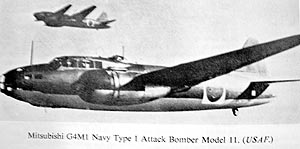
Mitsubishi G4M1 Navy Type 1 Attack Bomber ("Betty")
Francillon, R., Japanese Aircraft of the Pacific War,
p.378
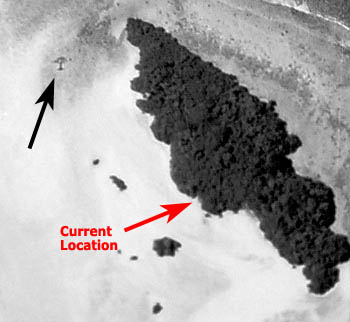
Photo courtesy of NARA, 2003
The two Frances bombers, however, deserve additional comment. First, Flip and I could find no debris consistent with the Frances crash sites in this and other photos from July 1944 - either they cannot be seen or they are not in the photograph field yet (eg, they crashed later). According to René J. Francillon's Japanese Aircraft of the Pacific War (Naval Institute Press, 1990, pp462-468), the Frances (P1Y1 Ginga, or Milky Way) because of serious hydraulics and power plant defects did not reach combat service until early spring 1945, long after the Americans had air superiority over Palau. After September 1944, I have found no record of the Japanese ever attempting an aerial attack over Palau again (except for a lone aircraft, most probably a seaplane from the Babeldaob area, making night attacks over the US Marines on Peleliu, which was shot down by VMF-541N). This might place these Frances crashes as occurring between July and September 1944. Additional archival review is underway. What these two Frances bombers were doing in Palau may never be determined, but with their having a maximum range of 2900 nautical miles, many things could have been possible.
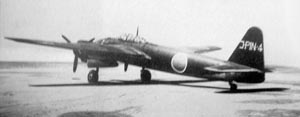
Yokosuka P1Y1 Ginga ("Frances")
Mikesk, R., Japanese Aircraft: Codenames and Designations, p.53
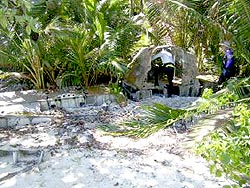
Pat entering Betty with Dan looking. © Val Thal 2003
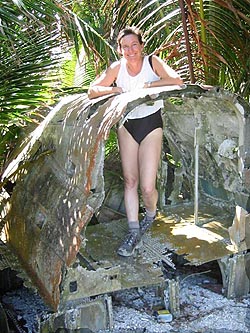
Val demonstrating turret opening. © Flip Colmer 2003
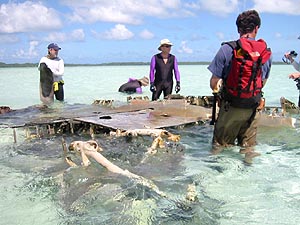
Pat with bent prop, Jennifer, Dan, Clem, and Flip's arm. © Val Thal
2003
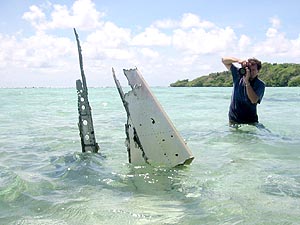
Clem photographing vertical stab. © Val Thal 2003
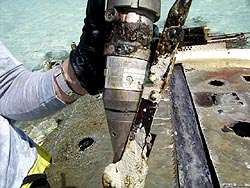
Dan's find: ID plate (very rare). © Val Thal 2003