
 P-MAN V - p. 7
ATTACHMENT 5:
Interviewing Palauan elders for their recollections of WWII concerning
downed aircraft and American POW's (3 AAF crewmen, 3 Navy UDT members
and others) with trips to three known Japanese military grave sites (and
one possible US POW execution site, according to two Palauan elders),
Babeldaob and Koror (02, 07 and 12 MAR 03)
A number of American airmen remain in Palau as MIA (although administratively listed as killed-in-Action (KIA)), Body Not Recovered (BNR). The problems in even identifying who the specific individuals are is difficult because 1) they were shot down (which is where the American record ends) and captured behind enemy lines many months before the war ended, 2) they stayed within Palau because the enemy was isolated, courtesy of the U. S. Navy and U. S. Marines, 3) the Japanese military (IJA, IJN) reportedly burned/destroyed all records before surrendering, 4) Palauan geography and 5) passage of time. Nonetheless, accounts of American POWs in Palau continue to come from interviews of Palauan elders, American and Japanese veterans and archival research.
This component of the P-MAN V expedition was an ongoing part of a joint effort with Professor Donald Shuster, University of Guam, the U. S. Army Central Identification Laboratory, Hawaii (CILHI) and the BentProp project, which began at least three years ago (please see reports sent to NHC and CILHI as well as my public P-MAN II, P-MAN III and P-MAN IV reports on this Web site for sequential updates). Professor Shuster and I had independently arrived at similar conclusions that a number of civilians (Professor Shuster) and Americans (several AAF, Marine and possibly Navy air crewmen shot down over Yap and Palau and up to 3 Navy UDT frogmen captured on Yap and brought to Palau) were captured and imprisoned in various places throughout Babeldaob and Koror - all as Prisoners-of-War (POWs). Post-war Japanese records to the contrary, a growing body of evidence now exists that these POWs were not shipped off-island, as claimed, but were executed without trial on the order of LT GEN Inoue, Commanding General of all Japanese military forces in Palau. CILHI has made two trips to Palau (2000, 2001 - both while P-MAN teams were in Palau) to search for one grave site of three American airmen and several priests/missionary families, all executed in SEP 44 around the Peleliu invasion. The efforts resulted in identification of one probable site (not explored) in Ngatpang State but no further efforts have been made, pending additional information. Since 2000, I have sought out and interviewed, with the help of Prof. Shuster and several Palauans, elder Palauans in Koror and Babeldaob who remember seeing captured Americans either in Koror (original HQ area) or Babeldaob (jungle HQ area after bombing started). I have also flown to Japan, and with the help of Prof. Shuster's wife as translator, interviewed two former Imperial Japanese officers who were in Palau during the war. One, Mr. Katsuyama, had been convicted of the one known beheading - that of LT Wallace Kaufman, an American 7th AAF navigator (member of the Custer crew, see above). The other former officer, Mr. Sakamoto, told me of at least two previously unreported executions of American airmen in the jungles of Babeldaob, near Inoue's HQ. These interviews were filmed and are available for review, courtesy of PostStar Productions.
On P-MAN V, we continued following up with Palauan elders in an effort to assemble several small pieces into a more cohesive picture concerning sightings of various airmen. We did learn considerable amounts of new information - all interviews are documented and co-translated on videotape (PostStar Productions). I will briefly summarize each interview (names specifically not referenced in this report although forwarded to appropriate agencies) and will consolidate them in a summary below.
Koror Elder 1: I interviewed this gentleman last year and again this year. He stated on both occasions that, while working for the Japanese, he saw at least two "frogmen" (his words) brought from Yap marched through Koror in late AUG 44 and taken to the headquarters in Ngatpang State. He believed they were subsequently executed but did not witness it. He also saw one B-24 shot down (we were able to narrow it down to most likely being B-24 '453 shot down on 01 SEP 44, with up to three airmen captured after parachuting out). These three airmen are believed to have been the airmen executed with the Catholic priest/missionary families.) He did not witness these executions either.
Koror Elder 2: I interviewed this 87 year-old gentleman on two occasions. He recalled seeing three "frogmen" (his words) at the jungle HQ in Ngatpang State. He stated that he saw them brought before an officer "with one star on each shoulder" and then saw them driven off to the southeast at dusk. He did not know what happened to the POW's but he thought they might have been executed. He did not recall seeing any other POW's.
Koror Elder Lady: the team visited this remarkable woman again during P-MAN V. She had been instrumental in 2001 in guiding the CILHI and the P-MAN III teams to the one probable execution site in Ngatpang State. She confirmed her belief to the P-MAN V team that that site was the execution site. (NOTE: War Crimes Trials records after WWII provide testimony that this execution did occur, that the bodies of the three airman and priests/missionary families were buried in a common grave, and that near the end of the war, their remains were exhumed, cremated and reburied "nearby" to hide the evidence. It is this second site that CILHI believes it located in 2001.)
Ibabong Elder: The son of Koror Elder 2 knew of an elder (also his uncle) in this village on Babeldaob who had some recollections. This elder did not work for the Japanese and during the war avoided them as much as possible. He stated that he had heard of the frogmen and had been told where they had been buried after their execution. He agreed to show us where he was shown they were buried. Surprisingly, he took us by 4-wheel drive vehicles directly to the vicinity where Katarina had taken us in 2001 near Ngatpang Hill (near the Police (Kempeitei) Station) and pointed to the same general area that she had. He also pointed out that the Japanese had a cemetery nearby. He stated that the Japanese expressly did not bury non-Japanese in their cemeteries but rather off to one side (e. g., to where he pointed). He said this cemetery belonged to the hospital, which had been located on the other side of the river from the Police Station.
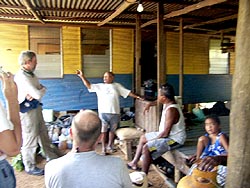
Palauan Elder pointing to location southeast of his village where he was
told
the "frogmen" had been buried after their execution. Clockwise
from Elder:
Joe (translating), Elder's granddaughter (flirting with cameraman), Dan,
Val's arm (photographing), and Pat (conducting interview). © Flip
Colmer Mar 2003
Finally, the son of the Ibabong Elder, also a hunter and guide, knew about the locations of at least four sites of potential importance: three cemeteries and a site referred to as "the General's House". One of these cemetery sites (in general area of Ngatpang Hill) was the hospital cemetery that his father had pointed out (see Ibabong Elder, above) to the east of which he had heard the frogmen had been buried (NOTE: the grave area pointed out for the frogmen is very near the burial site that Katarina showed us in 2001 for the civilians/airmen during P-MAN III).
A Palauan guide then showed us three other sites (two abandoned graveyards and one area called by them the "General's House"), all of which he said belonged to the Japanese military:
- The second cemetery was in the jungle and adjacent to a bunker. This cemetery appears to still contain human remains. I counted six undisturbed grave mounds in an area of 40X60 feet. This formal plot has a border of stones around it and each grave likewise was delineated by stones. The role of the bunker (Fig 5-2), placed into the side of a small hill about 100 feet SSW of the cemetery, is uncertain. It measures approximately 8X10 feet with walls two feet thick, is empty inside and may have been a bomb shelter as the only opening is a doorway (door missing) facing north toward the cemetery . Flip found evidence of a light rail system that appeared dismantled but heading in a westward direction. The Palauan guides told us this is one of two areas said to have had a Japanese flag pole made of solid gold (never found). Needless to say, this area has been exhaustively searched by Palauans, although only one grave appears to have been disturbed.
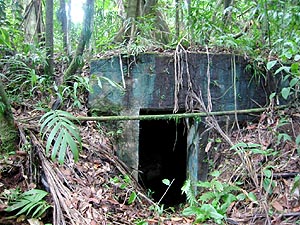
Japanese bunker near Japanese military cemetery.
© Val Thal 2003
- From this cemetery, our guide took us deeper into the jungle to what he called the "General's House" which was situated on a hilltop above a bend in a river. We found on the hill top several stacked Japanese helmets and part of a foundation (guide said the building had been stripped and burned after the war) and other debris. On the hillside down to the river, many deep pits (? fox holes or post war searches for loot) were seen. This site is in the general vicinity of a site a former Japanese IJA officer in 2001 pointed to me on a map - only he referred to it as the "Command Post". I believe the two may be the same. This area may be of importance as the possibility exists that at least one set of executions may have taken place here (see P-MAN III summary). The Palauans said that it is believed that the Japanese officers buried all their valuables in this area before surrendering - accordingly, this area has been heavily searched in the past (with no success).
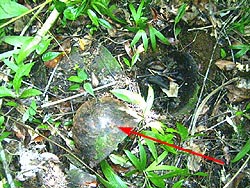
Stack Of Japanese helmets, each with a star in front
(red arrow) on top of hill, near former location of
the "General's House." © Flip Colmer 2003
- The third cemetery was on a hilltop along an east-west road. It appears to be abandoned and possibly exhumed. The Palauans believe some graves may still be present in the encroaching jungle. They pointed to an area and suggested that if the cemetery had been exhumed, the non-Japanese graves would have been left behind.
With these discoveries, I have attempted to tie together these observations with possible POWs. A part of this has included additional archival research. Most recently, through the great help of Mr. Tripp Wiles (Defense POW/Missing Personnel Office), I have uncovered the long-buried testimony of Julius Hamano, a former IJA officer who in 1947 provided testimony which confirms much of what we have painfully pieced together. This is summarized from my brief summary (previously sent to CILHI) as follows:
I. "New" File from Box 1366: Testimony of Julius Hamano, formerly an IJA intelligence officer and English translator in LTGEN Inoue's HQ.
This is a most interesting file for several reasons but most interestingly to me, the testimony of Julius Hamano (pp4-7, especially top of page 5) is the first admission I have seen in writing by a Japanese officer that multiple Americans were captured and interrogated at Inoue's Babeldaob HQ. This fits amazingly well with interviews we have been progressively collecting over the past four years (and which culminated in my April 03 report on the subject, which you have seen). That is, Hamano admits to the presence of at least 1) two sailors whom he interrogated (referred to as "frogmen" by the Palauans: CG Howard L. Roeder plus at least one unknown), 2) three airmen shot down in August 44 (could be the Arnett B-24 '453 crew lost 01SEP44 or the Rea B-24 '596 crew lost 25AUG44, most likely the former) and 3) LT Kaufman whom he interrogated. He specifically does not mention the civilians or any other individuals BUT he cleverly and precisely answered what he was asked: "How many prisoners of war were captured in the vicinity of Babelthuap Island and interrogated at the headquarters of the Inoue-butai?". Notably, later in his testimony (page 7) he refers to "the Naval Headquarters on Babeldaob Island" (30th Naval base) as another site presumably separate from the Inoue-butai. This leaves open the possibility that USN aviators shot down before the invasion of Peleliu (Operations DESECRATE ONE and SNAPSHOT) might have been captured and interrogated elsewhere. He also avoids admitting to the fate of the other POW's besides LT Kaufman when asked if they were sent "out of the Palau Island area to prisoner-of-war camps" by answering all but LT Kaufman "...were sent out of the area" (Page 5).
In summary, Hamano confirms the composite summary of our Palauan interviews that these Americans were in the Babeldaob area after being captured. To this extent, the Palauans have proven to be credible sources - this leads me to believe that the Palauan claims we heard during P-MAN V in MAR03 that the frogmen were executed near where the three American airmen were executed (subject of CILHI searches in 2000-2001) on Ngatpang Hill also have merit.
In order to attempt to analyze the above information, all relating to the disappearance of several known POW's, I have assembled the following working summary:
- The only remains found of executed Americans to date are those of LT Wallace Kaufman.
- At least two living Palauans independently saw, or were told of, at least two different groups of POW's. One group of POW's, the airmen executed with the civilians in SEP 44 (AC/POW), was seen by the Koror Elder Lady and was heard of by the Ibabong Elder. This execution is also well documented in the War Crimes Records. The second group of POW's (frogmen, FM/POW) was seen by two additional Palauans and was heard of by a third (Ibabong Elder). According to the U. S. Navy Seals magazine, Blast, the capture and shipment to Palau of CG Howard Roeder and one or two other UDT frogmen are well-documented.
- Each of these two groups of POW's, based on independent Palauan recollections, were taken to the same killing vicinity (near "Police (Kempeitei) station") and their remains buried in roughly the same quadrant in the field below the Police Station, to the west of the nearby Japanese hospital cemetery.
- AC/POW was the subject of a preliminary field search in 2000 and 2001 (no excavations). To date, FM/POW has not been the subject of an investigation due to lack of information (NOTE: to the best of my knowledge, while the airmen/civilian POW's were the subject of War Crimes hearings, the frogmen POW's were not).
- As related to me by a former IJA officer in Japan, a third set of two POW's may have been executed at the "Command Post" or somewhere nearby but this is less certain. (NOTE: This gentleman was potentially agreeable to returning to Palau if that would be helpful). This area may now have been identified by the P-MAN V team as the General's House.
- As related to me by a former U. S. N. clerk typist in Palau just after WWII, he was told by Palauans that one Naval aviator (by name) was captured and executed.
- A Palauan chief has related on two occasions to seeing a dead American airman with a tattoo on his left chest that he saw in the area of Inoue's jungle HQ.
- As it appears to have been the custom of the IJA to bury executed POW's not in, but somewhat adjacent to, their own cemeteries (e.g., LT Wallace Kaufman and the airmen/civilian POW's were both reported to be buried near Japanese cemeteries, respectively, in Koror and Ngatpang), the location of two new cemeteries in the Ngatpang/Ngaremlengui area and the confirmation of the third (near Police Station and hospital) offer additional specific search areas. In addition, in 2000, the P-MAN II team, working with Ngatpang chiefs and a guide, located and obtained GPS readings of what is believed to be the jungle headquarters of LTGEN Inoue. This is another site where executions may have occurred. At least one area there appeared to be a small (7X15 feet) grave site.
- From recently uncovered documents, Julius Hamano, former IJA officer provided testimony in 1947 supporting our findings that at least three American airmen (reported to have been executed mid-September 1944), 2 sailors (fates unknown) and LT Kaufman (known to have been executed approximately 20MAY45) were all brought to LTGEN Inoue's Babeldaob Headquarters for at least interrogation.
- Our efforts so far continue to support our belief that a number of POW's, at least 6 and possibly more American military, some who were reported by post-war Japanese officials as having been shipped off-island to the Philippines (and sunk by American submarines), were in fact executed by the Kempeitei (of the IJA) within the Palau Islands during the war. As we were leaving Palau, we became aware of at least one more elder who may have added information. We plan to interview him on our next trip. Our master guide, Joe Maldangesang, continues to network for additional witnesses.
The BentProp team feels, based on this composite of information, that consideration be given for further efforts to search for the remains of these POW's, particularly in the Ngatpang/Ngaremlengui areas. A particular area of interest remains near the Police Station on Ngatpang Hill.
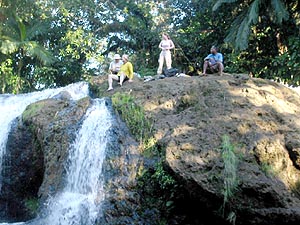
Jennifer prepares to cool off after a day of searching
on Ngatpang Hill (about 1.5 miles to the east of this photo).
This waterfall, according to Palauans, is near one of the
Japanese headquarters and barracks. © Val Thal, 2003