P-MAN IV - p. 11
b) Eil Malk Attempt, 09 April 02 P-MAN IV�s master guide, Joe, received a report of an intact crash site on a remote island (Eil Malk) in the southern Palauas, concerning which the team decided to make a preliminary sweep. Being the first full day of exploration, this was the first jungle trek for the P-MAN IV team. It also proved to be a learning experience. This region of Palau is uninhabited and, since the outlawing of firearms in Palau, hunters don�t come here anymore. With fathers no longer teaching their sons about hunting on these islands, there are no local guides.
Having already spent most of the day elsewhere, we planned a maximum total trip time of 90 minutes. We did not find anything on this short �break in� hike, although we did learn much about the need for equipment checks and team discipline while hiking through the jungle. Two members were injured after falling on the coral, but not seriously. We had a long debriefing session on the way back to Koror. A subsequent interview between Joe and his elderly Palauan contact confirmed that the elder, now quite frail, had seen an intact crash site several years back in a certain area deep in the island�s interior. This search will be taken up again on a later expedition.
 c)
Far-Western Coral Head Searches, 14 April 02 Albert, our friend
and fisher guide on previous expeditions, informed me about finding an
intact aircraft in about 30 feet of water near a coral head while night
spear fishing some years ago. While he knew the general area was near
the western barrier reef off southern Babeldaob, he could not say exactly
where it lies (which is why he may not have mentioned it previously).
While on the map the search area looked reasonable, in fact it wasn�t
- for a small team in a single dive boat without force-multipliers like
side scanning sonar or a magnetometer, the area proved vast. The P-MAN
IV team wound up investigating a series of seven coral heads near the
western edge of the barrier reef. Using a combination of scuba diving
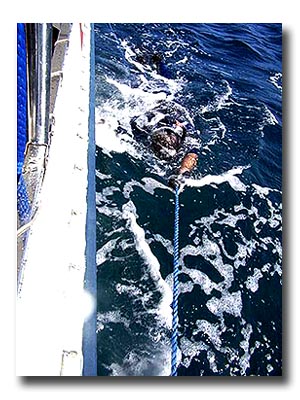
and pulling two snorkelers, one from each side of the dive boat, we surveyed
a substantial area of ocean but found no evidence of any aircraft. We
did find that the two-snorkeler arrangement, at about 2 knots, was an
efficient method for searching this area of ocean floor to depths of 30
feet.
c)
Far-Western Coral Head Searches, 14 April 02 Albert, our friend
and fisher guide on previous expeditions, informed me about finding an
intact aircraft in about 30 feet of water near a coral head while night
spear fishing some years ago. While he knew the general area was near
the western barrier reef off southern Babeldaob, he could not say exactly
where it lies (which is why he may not have mentioned it previously).
While on the map the search area looked reasonable, in fact it wasn�t
- for a small team in a single dive boat without force-multipliers like
side scanning sonar or a magnetometer, the area proved vast. The P-MAN
IV team wound up investigating a series of seven coral heads near the
western edge of the barrier reef. Using a combination of scuba diving
and pulling two snorkelers, one from each side of the dive boat, we surveyed
a substantial area of ocean but found no evidence of any aircraft. We
did find that the two-snorkeler arrangement, at about 2 knots, was an
efficient method for searching this area of ocean floor to depths of 30
feet.
d) Mid -Western Coral Head Searches, 14 April 02 Following investigating the outer coral heads, the P-MAN IV team reinvestigated a second series of coral heads closer in to southwestern Babeldaob for a site possibly containing aircraft debris, also seen by guide Albert and initially investigated by the PMANII team in 2000. Since this is in the general area of a reported F6F crash in 1944, we conducted another thorough water search but once again we were not successful. This particular stretch of ocean has a strong two way tidal current, which may have dislodged any debris field. This, combined with coral overgrowth, makes such water findings difficult. Near this area (and possibly related?), we visited a Hamilton � Standard propeller on a coral head. I had seen this prop first in 1993 with my wife, Susan, but at that time it had been vertical. Albert said that a boat had hit the prop a few years ago and bent it. Also over the intervening years, nearly a foot of new coral growth has completely covered the previously exposed hub (as seen by comparison of photos). Because the prop could have originated from several types of US aircraft, the team took a GPS reading and numerous measurements. Lacking writing capability on the coral head, each member of the team was required to memorize one measurement, which worked! Although I continue to research this prop, it continues to remain a mystery.
e) Lighthouse Crash Site, 23 April 02: Working with hunter guide Lazarus, we searched in the jungles of Ngaremlengui for an intact crash site that he found several years ago. As the area is not a common hunting spot, Lazarus was surprised to discover that tremendous overgrowth had occurred in the intervening years. Nonetheless the effort in searching in this area is relevant: LT Virginius Perry of VMF-121 crashed in this same area and remains MIA. After spending a day clearing the area with machetes without success, we ran out of time (last search day of the expedition). Lazarus will be researching the area in preparation for our next expedition.