
 P-MAN IV - p. 12
ATTACHMENT 5: Interviewing Palauan elders for their recollections of WWII concerning downed aircraft and American POWs
As with prior P-MAN expeditions, time was set aside to continue interviews with Palauans who might have knowledge of downed aircraft or airmen in Palau. On P-MAN IV, we were fortunate to interview several elders about their WWII recollections.
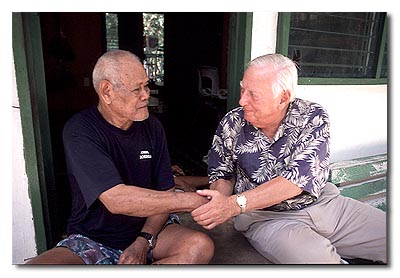 a)
Senator Whipps Interviews, 11-12 April 02 Senator
Surangel Whipps, who has helped us on numerous occasions over the past
nine years, took two days off from his busy senatorial schedule to facilitate
access to a number of elders. As a result, we interviewed four men on
Babeldaob who had memories to share. Three of these men were in their
teens and early twenties during those days; one was a young boy. All of
them remember the bombings by the USAAF B-24�s (which at first, and only
briefly, they thought were Japanese!), the Navy carrier strikes and then
finally the incessant Marine Corsair suppression raids. They all recounted
the hardships of war and each had his own stories about the many ways
they dealt with starvation and the Japanese occupation.
a)
Senator Whipps Interviews, 11-12 April 02 Senator
Surangel Whipps, who has helped us on numerous occasions over the past
nine years, took two days off from his busy senatorial schedule to facilitate
access to a number of elders. As a result, we interviewed four men on
Babeldaob who had memories to share. Three of these men were in their
teens and early twenties during those days; one was a young boy. All of
them remember the bombings by the USAAF B-24�s (which at first, and only
briefly, they thought were Japanese!), the Navy carrier strikes and then
finally the incessant Marine Corsair suppression raids. They all recounted
the hardships of war and each had his own stories about the many ways
they dealt with starvation and the Japanese occupation.
Two of the men remembered seeing a B-24 (� a bomber�) shot down over southern Babeldaob just before the invasion of Peleliu - one saw it explode over the channel between Babeldaob and Koror, with two or three parachutes. This younger Palauan also remembers finding, the next day, a dead American airman still in his flight suit washed up on a Rock Island on the southern edge of Babeldaob. Although the boy informed the Japanese military, he only recalls their removing his jewelry and other personal items without burial. The smell of decay kept the boy away from the area and he never returned (see Attachment 6 b) below).
Almost certainly, this series of events concerns a single aircraft, described separately in detail by these Palauans (see also paragraph d) below). These descriptions best fit with the B-24 flown by LT. James Arnett of the 307th BG (H), 13th AAF on 01 September 44, which was hit over Koror during a bombing run and blew up over Toachel Mid, between Koror and Babeldaob. This is the first time I have been able to obtain ground confirmation of the loss of this B-24 (an earlier report detailing my interview with an American eyewitness in an adjacent plane appears elsewhere on this Web site). What is new from these Palauans is that the bomber appears to have exploded into many pieces rather than crashing as a single unit. This could help explain why it has been so difficult to find this aircraft despite many attempts by BentProp teams in prior expeditions. One of the interviewed Palauans believes that the Americans who survived the crash were taken to the headquarters area near Ngatpang and were subsequently executed (this is consistent with the historical record: see the P-MAN III report on our efforts to locate the gravesite of these POWs).
The younger Palauan recounted the tale of another aircraft being shot down and crashing in some very tall grass adjacent to the mangroves near a rock quarry � he thinks no one ever went to look for that aircraft (now the subject of a later P-MAN expedition).
 Finally,
Senator Whipps introduced us to another elder, who recalls seeing an aircraft
crash into the ocean along the southwest side of Babeldaob. He believes
he can recall the spot where the single-engine plane hit the water (now
the subject for a later P-MAN expedition). This site may be related to
the propeller imbedded in the coral mentioned above. We will want to take
him to that site.
Finally,
Senator Whipps introduced us to another elder, who recalls seeing an aircraft
crash into the ocean along the southwest side of Babeldaob. He believes
he can recall the spot where the single-engine plane hit the water (now
the subject for a later P-MAN expedition). This site may be related to
the propeller imbedded in the coral mentioned above. We will want to take
him to that site.
b) Chief Interview, 23 April 02 I interviewed an elder Chief who lives in the state of Ngaremlengui and who during WWII worked as an assistant to the Japanese Kempetei (military police), one of whose responsibilities was American POWs. He told me we were the first ever to ask about his experiences. He recalled seeing several American aircraft crashes, all of which, from his translated descriptions, are ones we have investigated or continue to investigate. While he recalled hearing of executions, these all occurred in the next state over from his at the Japanese headquarters (Ngatpang) so he never saw such executions.
c) Koror Elder Interview (1), 24 April 02 On my last P-MAN IV day in Palau, I interviewed this elder, who worked as an apprentice for the South Seas Bureau (Japanese pre-war civil administration) and then for the Kempetei as an errand boy on Koror until they moved to Ngatpang. Jonathan recalled seeing two �frogmen� (his words) who had been captured on Yap in early August 1944 (before the American bombers began seriously attacking Koror) and brought to the Kempetei in Koror. While he was not allowed to get close to them, he recalled their being tied up together with one having a serious head injury. He was told later that these American frogmen were executed in Ngatpang but he was never given any details. This report is confirmed by facts: on 9 July 44, CG Howard L. Roeder and one, or possibly two, other frogmen after leaving a submarine were captured off Yap and believed taken to Koror. They remain MIA.
He also independently confirmed seeing a B-24 being shot down a few weeks later by AAA fire after bombing Battery Hill to the north (�the plane dispersed in the air�). He also recalled seeing two or three POWs in Ngatpang, again from a distance. The timing, location, number of POWs and similarity of reports from other Palauans interviewed during P-MAN IV strongly suggest this was the Arnett B-24 mentioned above. He was told these POWs were also executed in Ngatpang by the Kempetei but did not witness the execution. This interview, which compares well against known facts, tends to dispel a hypothesis that I had been entertaining that US Army POWs and Navy/Marine POWs may have been handled separately by the corresponding Japanese services on Palau. It appears thus far that executions of Americans on Palau were solely the work of the Kempetei. This may increase, slightly, our chances of finding the many still-missing POWs.
d) Koror Elder Interview (2), 13 and 18 April 02 Through our guide Joe, I interviewed a very old Palauan who stayed on Koror during WWII and lived through the many American bombings. I was most interested in determining if he knew anything about the crash of Major Nelson but he could only recall the two B-24s which crashed near his present home (Dixon, 13th AAF on 28 Aug 44, and Custer, 7th AAF on 4 May 45; reports on both can be found elsewhere on this Web site).
e) Koror Elder Interview (3), 21 April 02 Through Joe, I interviewed one other Palauan who was too young to remember anything but had in his possession a small tool kit which he said his father took from the wreckage of the Custer B-24. I held that small socket wrench set in my hand for a few moments before returning it.
f) Future Interviews
Through Joe and others, I attempted a number of other interviews but scheduling
on this busy trip became an issue. These have by necessity been deferred
to later P-MAN expeditions. Unfortunately time is taking its toll on Palauan
elders whom I still need to interview concerning POWs � between P-MAN
III (November 2001) and P-MAN IV (April 2002), at least two of these elders
passed away.