
 P-MAN IV - p. 9
ATTACHMENT 3: Conducting archeological field searches on 2 previously discovered crash sites
a) Coral Head Crash Site (P-MAN
II), 10-11 April 02 In 2000, the P-MAN II team
described finding a crash site in several feet of water on a coral head
west of Ngatpang Bay. Preliminary snorkeling at that time by Chip Lambert
and myself indicated it was an American aircraft (e. g., .50 cal ammunition
in the debris) but no further identification could be made. On 10 April
02, we did a preliminary snorkeling search of the debris field with Bill
and Mary Alice Cantrell on board. 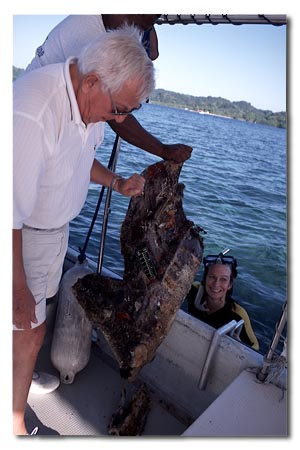 Bill
helped in identification of various parts, which we temporarily raised
to the surface for his review from the boat.
Bill
helped in identification of various parts, which we temporarily raised
to the surface for his review from the boat.
On the 11th, the P-MAN IV team returned (without me, since I was interviewing Palauan elders that day) and prepared a detailed archeological report of the debris field, led by team archeologist, Bill Belcher. This study resulted in a considerable expansion of the debris field both in number of parts found and area of the crash site. In addition to the debris found on top of the coral head, Flip Colmer found a large piece of the aircraft along the eastern base of the coral head in deeper water, now almost covered by coral.
No human remains were found. Review of the composite debris field pattern suggests that the aircraft most likely crashed in an approximately east-west direction, probably crashing from the east. Various observations and measurements of parts (e. g., horizontal/vertical stabilizer, cylinder head) preliminarily indicate that the aircraft was a Corsair, which narrows the possibilities of who might have flown it and when. Historical records indicate at least two, and possibly three Corsairs were shot down in this area. Additional study is in progress.
b) Rock Island Avenger, 21-22 April 02 A number of years ago, a Navy TBM Avenger was discovered by a visiting pilot, Duncan Cameron, while exploring the rock islands along the western side of Ngeruktabel, which he immediately reported to the US consulate. While most of the Avenger lies upside down in ~ 25 feet of water along the northern base of the island, parts can also be seen on the island above the wreck.
Members from CILHI subsequently were called in from Hawaii and were able to confirm the crew�s identities from one set of dog tags (belonging to ARM2c Louis J. Sumers). They also removed some remains found on this Rock Island. This Avenger, flown by LT(jg) Jarrell S. Jenkins, with third crewmember AMM1c Thomas B. Conlen, was last seen in action by his USS Cabot wingmen beginning a dive on 30 March 44.
Although the crash was not witnessed,
the aircraft appears to have impacted first onto the northern face of
the coral island, then slid into the water at the island�s base. Dan Bailey
later described the site in detail in his book, World War II Wrecks of
Palau. The P-MAN IV team reexamined both the water site and the land site,
photodocumenting the area and taking GPS readings. Considerable debris
from the cockpit area, including canopy structure, remains on the island,
which suggests the Avenger impacted inverted onto the island before sliding
down into the water. The upside down port wing still displays an intact
Yag radar antenna, which represents an early aerial application of this
technology.