
 P-MAN IV - p. 8
ATTACHMENT 2: Finding 3 new aircraft debris fields consistent with probable crash sites
a) Ulong "Fuel Tank (?),"
09APR02 A divemaster working in Palau, Daniel
Callahan, notified me by e-mail (through www.bentprop.com) of possible
aircraft debris buried in the sand on a beach on Ulong (Island). We
found a single aluminum container, without other obvious debris, near
a picnic site popular with both Japanese and American tourists.  It
appeared in remarkably good shape except for some jagged openings in the
top surface of the structure. Its longitudinal axis lay approximately
north-south. After removing most of the sand from around the structure,
we identified it tentatively as an aviation-related fuel tank because
of the characteristic aluminum construction with riveting and internal
baffling system. One small opening was found, on the west face, toward
the northern side of the tank. On the south face is a centermounted flange.
The tank has a trapezoidal shape with rounded corners, wrapping around
the two flat vertical surfaces, which form the north and south walls.
The tank is symmetric along all three of its axes. This symmetric shape
suggested to the team that it might have been a main fuel tank possibly
spanning across the fuselage over the main spar(s) of the wings, with
the east and west flat walls facing fore and aft. Our best guess is that
the tank had not been painted. We took key measurements: ~ 7 feet long
X 3 feet wide X 2 feet tall, containing 5 internal baffles with numerous
4 inch diameter circular openings in the baffles (probably inspection
holes), and photo-documented the site.
It
appeared in remarkably good shape except for some jagged openings in the
top surface of the structure. Its longitudinal axis lay approximately
north-south. After removing most of the sand from around the structure,
we identified it tentatively as an aviation-related fuel tank because
of the characteristic aluminum construction with riveting and internal
baffling system. One small opening was found, on the west face, toward
the northern side of the tank. On the south face is a centermounted flange.
The tank has a trapezoidal shape with rounded corners, wrapping around
the two flat vertical surfaces, which form the north and south walls.
The tank is symmetric along all three of its axes. This symmetric shape
suggested to the team that it might have been a main fuel tank possibly
spanning across the fuselage over the main spar(s) of the wings, with
the east and west flat walls facing fore and aft. Our best guess is that
the tank had not been painted. We took key measurements: ~ 7 feet long
X 3 feet wide X 2 feet tall, containing 5 internal baffles with numerous
4 inch diameter circular openings in the baffles (probably inspection
holes), and photo-documented the site.
Can you help us to identify this object? We were not able in the field to associate a specific aircraft type, nationality or date with this site - or even to confirm that this object is in fact from an aircraft. One observation suggests this tank may perhaps be WWII related: low along the eastern wall of this tank we found a diagonal line of 3 or 4 inwardly facing puncture holes, each approximately 4-6 inches apart and ~ a half inch in diameter (bullet holes?).
View a video clip of the mystery tank and let us know if you think you can identify this object. The video clip gives you a much better idea of the object's size and appearance than the still photo on this page. The clips listed below are identical except for file size and format, so just choose one for which you have a viewer. If you have a broadband connection, the larger files are of sufficiently better quality to justify their size; the smaller ones sacrifice some visual quality in the interest of file-size reduction (faster download), but they'll still give you a fair idea of what this thing looks like. The .wmv file uses the Windows Media Player. The .ram files require the RealOne player. And the .mov files require the QuickTime player. Need to download one of the free viewers? Here's where you'll find the RealOne player, the Windows Media Player, and the QuickTime player.
Larger files (better quality):
Smaller files (lower quality, but faster downloads):
- Real Media file - 376 KB (very small file, but not bad quality)
- QuickTime file - 1.3 MB
 b)
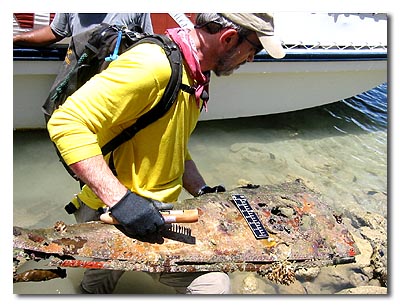
Boat Works Aircraft Debris Field, 13APR02 While
departing from the team boat anchored in shallow water near a bombed out
Japanese boat repair facility near Koror (actually to look for another
crash site), I unexpectedly stepped on and identified several pieces of
debris characteristic of an aircraft (eg, curved aluminum with rounded
corners, riveting, ribbing along internal curvatures). The pieces were
small in number and size (none bigger than 2 feet X 3 feet X 6 inches),
although one piece had a particular port, which may aid in later identification.
Once again, in the field, we were not able to identify the aircraft type
based on our preliminary findings. Photographic analysis of the pieces
is in progress, although additional exploration at the site will most
likely be necessary to determine the extent of the debris field.
b)
Boat Works Aircraft Debris Field, 13APR02 While
departing from the team boat anchored in shallow water near a bombed out
Japanese boat repair facility near Koror (actually to look for another
crash site), I unexpectedly stepped on and identified several pieces of
debris characteristic of an aircraft (eg, curved aluminum with rounded
corners, riveting, ribbing along internal curvatures). The pieces were
small in number and size (none bigger than 2 feet X 3 feet X 6 inches),
although one piece had a particular port, which may aid in later identification.
Once again, in the field, we were not able to identify the aircraft type
based on our preliminary findings. Photographic analysis of the pieces
is in progress, although additional exploration at the site will most
likely be necessary to determine the extent of the debris field.
c) Peleliu F6F Hellcat Wing, 15APR02 Our Peleliu guide, Tangie Hesus, took us to the intact wing of an F6F Hellcat, which appeared to have been moved to its current location. The wing, lacking specific aircraft or unit identification of any kind, appears to have been sitting on its ventral surface for some time, with the dark blue dorsal surface with a white star-and bar remarkably well preserved (perhaps covered or in shaded area?).
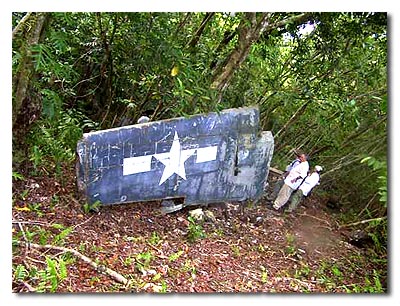
Its three machines guns were missing.
It is not clear if this wing is part of a crash or was scrapped during
or after the war. Early after the invasion of Peleliu, a night fighter
squadron of Marine Hellcats (VMF-541 (N)) was stationed on Peleliu, although
no reports of crashes from that unit have been found. In addition, several
F6F Navy Hellcats were shot down during the fast carrier attacks prior
to the Peleliu invasion and to date none have ever been located. If this
is part of a crash site, it will be the first Hellcat crash site found
in Palau. Additional work will be necessary to attempt to backtrack to
the original site where it lay to make further determinations.