 
Mississinewa
is hit
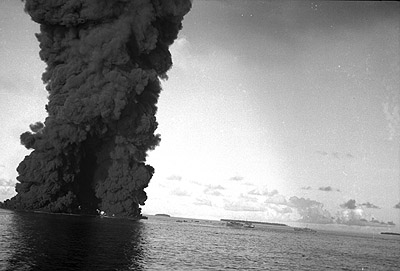 Of these five Kaitens, one hit the reef and exploded, another
foundered outside the reef and was sunk by aircraft, and the USS Case,
at the entrance to Mugai Channel, rammed a third. Two entered the lagoon.
One was sunk by depth charges from the USS Rall and the last Kaiten made
it to its target, ramming and sinking the USS Mississinewa at 5:45 a.m..
While many feel the 'successful' Kaiten was from I-36, based on our observations
of the location and orientation of the USS Mississinewa, the sinking is
more consistent with an attack from an I-47-launched suicide sub. Furthermore,
using Japanese documents describing assigned attack routes, we support
the difficult-to-prove theory that Sub-Lt. Nishimi piloted the Kaiten
which sank the USS Mississinewa. Interestingly, his Kaiten was the only
one to sink a US Navy vessel by itself; a subsequent attack in the Philippines
on the USS Underhill damaged, but did not sink, that ship - it was later
sunk by "friendly fire" due to the extensive damage incurred
from that Kaiten. Of these five Kaitens, one hit the reef and exploded, another
foundered outside the reef and was sunk by aircraft, and the USS Case,
at the entrance to Mugai Channel, rammed a third. Two entered the lagoon.
One was sunk by depth charges from the USS Rall and the last Kaiten made
it to its target, ramming and sinking the USS Mississinewa at 5:45 a.m..
While many feel the 'successful' Kaiten was from I-36, based on our observations
of the location and orientation of the USS Mississinewa, the sinking is
more consistent with an attack from an I-47-launched suicide sub. Furthermore,
using Japanese documents describing assigned attack routes, we support
the difficult-to-prove theory that Sub-Lt. Nishimi piloted the Kaiten
which sank the USS Mississinewa. Interestingly, his Kaiten was the only
one to sink a US Navy vessel by itself; a subsequent attack in the Philippines
on the USS Underhill damaged, but did not sink, that ship - it was later
sunk by "friendly fire" due to the extensive damage incurred
from that Kaiten.
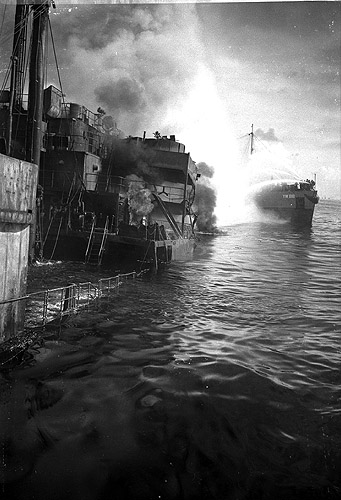 The USS Mississinewa was loaded with 440,000 gallons of
aviation gasoline and a full load of fuel oil. However, aviation fuel
had been pumped from the #3 wing and centerline tanks and bow wing tanks
#1 and #2. On orders from Captain Phillip Beck, these tanks had not been
"purged" (filled with seawater), a procedure used to reduce
the danger from the residual, highly volatile fumes.
We confirmed that the Kaiten hit the oiler on the starboard side, most
likely (based on our observations) between the #2 and #3 wing gasoline
cargo tanks forward of the bridge. Fumes in these tanks probably exploded
with as much force as the initial impact of the sub's warhead. It tore
a gaping hole almost 40 feet in length and down to the keel on both the
port and starboard sides.
The USS Mississinewa was loaded with 440,000 gallons of
aviation gasoline and a full load of fuel oil. However, aviation fuel
had been pumped from the #3 wing and centerline tanks and bow wing tanks
#1 and #2. On orders from Captain Phillip Beck, these tanks had not been
"purged" (filled with seawater), a procedure used to reduce
the danger from the residual, highly volatile fumes.
We confirmed that the Kaiten hit the oiler on the starboard side, most
likely (based on our observations) between the #2 and #3 wing gasoline
cargo tanks forward of the bridge. Fumes in these tanks probably exploded
with as much force as the initial impact of the sub's warhead. It tore
a gaping hole almost 40 feet in length and down to the keel on both the
port and starboard sides.
Of the 278 enlisted men and 20 officers on board at the
time of the attack, 63 (3 officers and 60 enlisted men) died, most forward
of the bridge and many in the forward crew berthing, as the area was consumed
with flames. The situation further deteriorated when a second explosion,
presumably the 5-inch ammunition magazine, occurred at 6:05 AM. (In addition
to the details contained in this synopsis, Mike Mair, son of one of the
ship's surviving crew members, has compiled vivid descriptions of the
carnage and confusion from the survivors. These recollections are beyond
the scope of this summary but may be found in a draft of the first chapter
of his book provided on the http://www.ussMississinewa.com web site.)
Rescue efforts
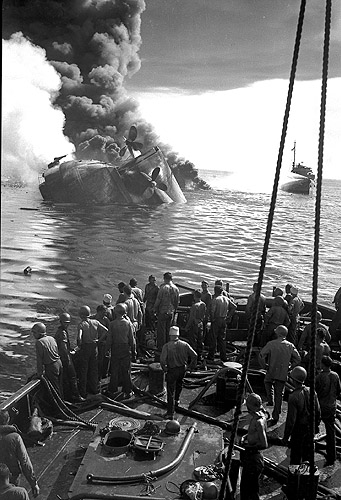 While many ships and one Kingfisher aircraft were
important to the rescue of the survivors, the account of the fleet tug
USS Munsee, ATF-107, is most relevant to our story. The Munsee headed
southwest down the Urushi anchorage toward the stricken USS Mississinewa
(the "Miss"). Destined to play a significant role in the fire
fighting and rescue efforts, the Munsee had aboard Storekeeper 2nd Class
Simon "Sid" Harris who received permission from his ship's captain
to photograph the rescue effort from the deck. His 37 black-and-white
photographs, documenting these efforts, were instrumental in our team
relocating the Miss. By 8:30 AM, the fires had been quenched. Unfortunately,
the Mississinewa had taken on too much water in the attempt to save her
and the bow dipped below the surface of the lagoon. The fire fighters
abandoned ship as it slowly rolled to the port. It continued to roll as
the stern rose, displaying its twin, four-bladed screws and then disappeared
for the next 57 years beneath the still burning, oil-coated ocean.
While many ships and one Kingfisher aircraft were
important to the rescue of the survivors, the account of the fleet tug
USS Munsee, ATF-107, is most relevant to our story. The Munsee headed
southwest down the Urushi anchorage toward the stricken USS Mississinewa
(the "Miss"). Destined to play a significant role in the fire
fighting and rescue efforts, the Munsee had aboard Storekeeper 2nd Class
Simon "Sid" Harris who received permission from his ship's captain
to photograph the rescue effort from the deck. His 37 black-and-white
photographs, documenting these efforts, were instrumental in our team
relocating the Miss. By 8:30 AM, the fires had been quenched. Unfortunately,
the Mississinewa had taken on too much water in the attempt to save her
and the bow dipped below the surface of the lagoon. The fire fighters
abandoned ship as it slowly rolled to the port. It continued to roll as
the stern rose, displaying its twin, four-bladed screws and then disappeared
for the next 57 years beneath the still burning, oil-coated ocean.
|
