The
Search for USS Mississinewa - 2 The
Search for USS Mississinewa - 2 
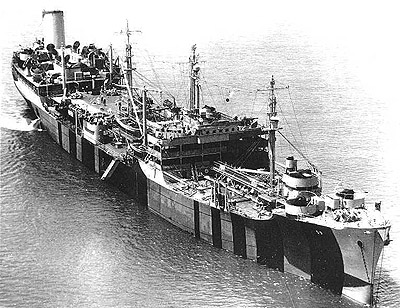
Where is Ulithi? Ulithi atoll (10º00' N, 139º40' E) is a remote cluster of flat, coral islands crowning the tip of a steep seamount located between the western Pacific islands of Yap and to the northeast, Guam. Part of the vast, far-ranging, complex of islands designated the Western Carolines, the islands of Ulithi form a ring around the partially protected, deep, approximately 200 square mile lagoon that was to become the western most staging area for the US Pacific fleet during W.W. II. Captured from the Japanese, without resistance, on 20 September 1944, the lagoon anchorage served as a service, supply and repair facility in support of the battles of Leyte Gulf, Okinawa and the final push by US forces to the Japanese mainland. The Navy abandoned the atoll in 1947, and except for a Coast Guard LORAN outpost, also later abandoned, the island returned to its pre-war state, supporting a subsistence life-style for about 700 inhabitants. The Kaiten manned torpedo Based on the concept of the suicide aircraft or "Kamikazes, in the fall of 1944 the Japanese implemented another weapon system of desperation, the "Kaiten" or suicide manned-torpedo, built around the successful Type 93 "Long Lance" fleet torpedo. The Kaiten was rushed into combat use in an attempt to stem the Allied forces' westward advance. The Type-1 Kaiten ("Turning of the Heavens" or "Heaven Shaker") that attacked the USS Mississinewa was essentially a 48 foot long, 8.3-ton, manned torpedo packed with 3418 pounds of high explosives. Launched from specially adapted I-class mother submarines, single pilots guided their unwieldy vehicles usually at depths between 15 and 40 feet at speeds up to 30 knots. Three mother submarines, each bearing four Kaitens, were selected to participate in the initial or "Kikusui" mission assigned to these weapons. Their target: the US fleet anchored in Ulithi lagoon.
The mother submarines were to approach the Ulithi lagoon passages and release the Kaitens against targets among Rear-Admiral Frederick Sherman's Task Group 38.3 and Commodore W.R. Carter's Service Squadron 10, which occupied the berthing areas within the lagoon. However, en route, one submarine, I-37, was sunk by American depth charges while transiting the Kossol passage north of Palau. Early in the morning of 20 November 1944, I-47, on
station east of Lossau Island, successfully launched all four Kaitens
northwest toward the lagoon. Sub-Lt. Sekio Nishina, the co-inventor of
the Kaiten, piloted one of these suicide subs. Simultaneously, I-36, sitting
under 30 feet of water further to the northeast, was in the process of
launching its weapons. Because of a number of malfunctions, only one Kaiten,
piloted by Ensign Taichi Imanishi, was released from I-36 toward Mugai
Channel at 4:54 a.m. |
|
| Page last modified 17 May 2003 | |

- Main Site
- Expeditions
- Our Story
- Miscellany