
 P-MAN II - 13
 On
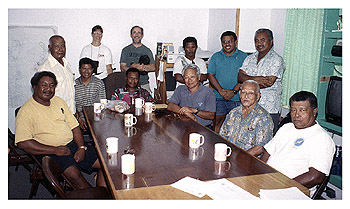
20 October, Chip, Pam and I showed up at the office of Ngatpang State for our
9:30am appointment with the chiefs. Five chiefs were present and, after the meeting
started, Shallum Etpison, also a Ngatpang chief, joined us. I presented to the
chiefs the story about the captured aviator and pursued the possibility of locating
the Japanese jungle HQ. One elder chief, a noted artist in Palau, spoke up and
told the following story. He remembers as a youth being shown a captured aviator
at the Japanese jungle HQ in Ngatpang, whom he said was from Peleliu. The aviator
had light brown hair, was 5'8-9" tall with a big build, was in shorts and
combat boots and had a tattoo of a sailing ship on his left chest. He was chained
to two Palauans. At some point, he apparently tried to talk one of the Palauans
into helping him escape and swim out to an island to the west.
On
20 October, Chip, Pam and I showed up at the office of Ngatpang State for our
9:30am appointment with the chiefs. Five chiefs were present and, after the meeting
started, Shallum Etpison, also a Ngatpang chief, joined us. I presented to the
chiefs the story about the captured aviator and pursued the possibility of locating
the Japanese jungle HQ. One elder chief, a noted artist in Palau, spoke up and
told the following story. He remembers as a youth being shown a captured aviator
at the Japanese jungle HQ in Ngatpang, whom he said was from Peleliu. The aviator
had light brown hair, was 5'8-9" tall with a big build, was in shorts and
combat boots and had a tattoo of a sailing ship on his left chest. He was chained
to two Palauans. At some point, he apparently tried to talk one of the Palauans
into helping him escape and swim out to an island to the west. 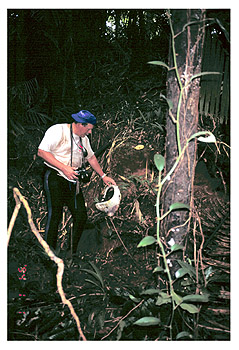 The Palauan was too afraid to help. Although the elder did not see what happened
to the airman, he feels certain he was executed shortly thereafter. The elder
said he would be willing to instruct a young hunter guide to show us where the
HQ was located, although he cautioned that it was deep in the jungle and had not
been visited since the end of the war. Gilbert immediately phoned Ngatpang to
contact Elechang, who would be our guide the next day. That evening we took our
boat guide, Joe, and his wife, Ester, to dinner to thank him for all the hard
work he did for us.
The Palauan was too afraid to help. Although the elder did not see what happened
to the airman, he feels certain he was executed shortly thereafter. The elder
said he would be willing to instruct a young hunter guide to show us where the
HQ was located, although he cautioned that it was deep in the jungle and had not
been visited since the end of the war. Gilbert immediately phoned Ngatpang to
contact Elechang, who would be our guide the next day. That evening we took our
boat guide, Joe, and his wife, Ester, to dinner to thank him for all the hard
work he did for us.
On 21 October, we left Neco Marine with Joe for the Ngatpang dock, where Chief Rebekuul and our guide, Elechang, met us. We loaded our gear on a truck and headed in a southeasterly direction until we hit an intersection near Koksai (where interestingly, Professor Shuster and CILHI had been looking for their executed prisoners). We turned onto an intersecting road to the northeast and pulled off the road after a quarter mile. We headed immediately into the jungle continuing in a northeasterly direction along a creek bed (Note: we estimate we were about five miles south of the Ngatpang Corsair site we had examined on 20 October). We maintained that general direction for about 45 minutes, and began to see small caves dug into the red clay hillside. We saw pieces of apparently discarded equipment, the biggest being a generator cart. About 15 minutes later, we turned to the southeast and immediately entered a large canyon, generally oriented in a southeasterly direction. We were in the bottom of the canyon, following a creek bed, and could see many caves dug into the cliffsides. Elechang took us across the canyon to a series of caves dug out of rock and announced we were at the jungle HQ. We knew immediately this was an area that had been inhabited by many people. We also realized with the time available, we would only be able to do a preliminary field survey. Chip, Joe and I entered the rock caves, which we found were interconnected with multiple openings. We also found the cave system surprisingly empty and clean, unlike our Peleliu experiences. Chip found the remains of an electrical lighting system. We then split up to maximize our time. Chip went to the southeast and I went to the northwest. Chip found a series of concrete steps leading down hill, across the creek and back uphill. I did not find much in my area to the northwest, although I found a break in the jungle canopy and managed after a few minutes to get a stable GPS reading. Chip, working his way uphill on the far side of the creek, found a ceramic urinal (made in Osaka) lying on the ground outside of a cave overgrown with roots. This was starting to look like a HQ!
We all climbed to the top
of the ridge. Joe immediately found a large amount of telecommunication gear,
including several batteries, a large switchboard and an empty carrying case. We
noticed many insulators in the trees for telephone and power lines. Joe then found
an unexploded 500-pound iron bomb, lying vertically with the fins skyward. This
was located on the ridge right above the urinal Chip found. Pam found an area
of interest about 30 yards south of the bomb on the top ridge. This area was a
depressed clearing approximately 7 feet by 15 feet, with mounds of dirt to one
side. We noted this as a possible site for CILHI to investigate. A number of smaller
finds were made but, once again, we ran out of time and headed back out in a heavy
rain.

