
 P-MAN II - 12
Pam and I did a video survey of the crash site, referencing each item relative to the propeller location. When viewed overall, a pattern emerged: the fighter appears to have crashed from a northwesterly direction in a not-too-steep angle of attack. As it crashed through the canopy, one wing ripped off and fell behind the fuselage. The stabilizers, elevators and rudder probably had ripped off earlier and lay further back to the northwest. When the fuselage impacted, the forward aspect of the fuselage separated from the remaining tail assembly. The engine, probably with the propeller still spinning ripped or torqued out of the fuselage and, along with the nose/cowling assembly landed to the side of the fuselage. The seat ejected forward, landing about 10 yards in front of the fuselage.
We found no ordnance (eg, machine guns).
The team decided not to touch the seat, but Lazarus and Dwight dug it
out anyway. 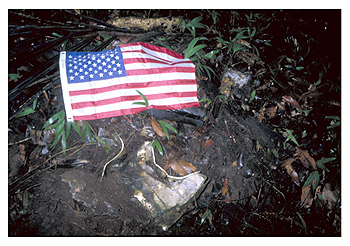 We
found no obvious human remains. By the time we completed the preliminary
survey, the sun was starting to set and (even with two MD's present) we
were substantially dehydrated: we had to leave. I had brought an American
flag and placed it off the ground above the aviator's seat. We had a brief
ceremony for the aviator. Even if he did bail out, the odds of surviving
transiently were miniscule and, if he did survive, since he was in enemy
territory, he would have been captured rapidly. No captured aviators are
known to have survived the Palau air campaign. The trek out was exhausting
but we made it back in 2.5 hours and each one of us drank a quart of Gatorade®
and a quart of water immediately after getting to the boat. Greg and Reid
left that night for Hawaii, their field part of the P-MAN II expedition
completed.
We
found no obvious human remains. By the time we completed the preliminary
survey, the sun was starting to set and (even with two MD's present) we
were substantially dehydrated: we had to leave. I had brought an American
flag and placed it off the ground above the aviator's seat. We had a brief
ceremony for the aviator. Even if he did bail out, the odds of surviving
transiently were miniscule and, if he did survive, since he was in enemy
territory, he would have been captured rapidly. No captured aviators are
known to have survived the Palau air campaign. The trek out was exhausting
but we made it back in 2.5 hours and each one of us drank a quart of Gatorade®
and a quart of water immediately after getting to the boat. Greg and Reid
left that night for Hawaii, their field part of the P-MAN II expedition
completed.

