
 P-MAN II - 7
On 16 October after a long and unrewarding
morning of diving along the eastern reef of Babeldaob, the team returned
to Ngargol to look for the third of three debris fields that Chip Lambert
had researched. 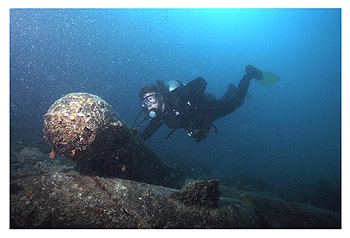 The
team dove on the site, while I stayed on board. I knew Chip found something
because almost immediately, his yellow buoy hit the surface and all the
dive bubbles congregated around one spot. They had hit a mother lode of
a ship debris field. It was clear that this had been a Japanese minesweeper,
because a great deal of gear, including paravanes and cables, sat on the
ocean floor in ~ 40 feet of water. It was also clear that this site had
not been discovered previously because of the large number of Japanese
artifacts remaining there. Chip and Greg took numerous underwater photographs
to document the site, because the artifacts in all likelihood would shortly
disappear, once word got out about the find. This find raised everyone's
spirits, as the aircraft searches thus far had not been productive.
The
team dove on the site, while I stayed on board. I knew Chip found something
because almost immediately, his yellow buoy hit the surface and all the
dive bubbles congregated around one spot. They had hit a mother lode of
a ship debris field. It was clear that this had been a Japanese minesweeper,
because a great deal of gear, including paravanes and cables, sat on the
ocean floor in ~ 40 feet of water. It was also clear that this site had
not been discovered previously because of the large number of Japanese
artifacts remaining there. Chip and Greg took numerous underwater photographs
to document the site, because the artifacts in all likelihood would shortly
disappear, once word got out about the find. This find raised everyone's
spirits, as the aircraft searches thus far had not been productive.
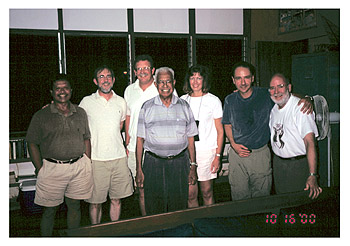 On
the evening of 16 October, Professor Shuster introduced the P-MAN team
to Father Felix, a Palauan priest who trained in the United States and
had lived around the world and now has responsibility for the Catholic
churches throughout Micronesia. He was born on Koror but, as a child,
moved voluntarily with his family, to caves in southern Babeldaob, when
the aerial hostilities broke out over Palau between Japan and the United
States.
On
the evening of 16 October, Professor Shuster introduced the P-MAN team
to Father Felix, a Palauan priest who trained in the United States and
had lived around the world and now has responsibility for the Catholic
churches throughout Micronesia. He was born on Koror but, as a child,
moved voluntarily with his family, to caves in southern Babeldaob, when
the aerial hostilities broke out over Palau between Japan and the United
States.
He remembered vividly the first American air attacks in March and July 1944 and recounted watching the battles in the skies above his cave-home. His father and two brothers were killed during WWII, one brother the victim of an American strafing run. The main purpose of our visit was to discuss what Father Felix knew of the executed missionaries and airmen.
He does not know why the missionaries
were executed. He does recall B-24 bombers flying overhead but never saw
one get shot down. He gave us the name of a Japanese man, who as a boy,
did see a B-24 get shot down around the southwestern end of Babeldaob
(Note: this could be a description of the Rea B-24, for which we also
have been looking). Although we did not learn any new specific information,
Father Felix spent two hours describing the times of WWII as a Palauan
youth. This enriched and reinforced our understanding of the hardships
the locals went through during the Japanese occupation.

