
 P-MAN II - 5
On 10 October 2001, we re-entered Toachel Mid armed with our very sensitive and (we thought) calibrated magnetometer. Between 10 October and 17 October, we surveyed the northern side of Toachel Mid from the northwestern edge east of the bridge (under construction)(~N 7° 21.5'/E 134°30.5') all the way to the southeastern edge off of the channel (~N 7° 19.8'/E 134°31.3'), which represents more than two square miles. We also surveyed the southeastern edge of Babeldaob along the coastal reef from ~N 7° 20'/E 134°33 to ~N 7° 22.5'/E 134°35.5'.
Although we noted many magnetometer hits, repeated dives on each site failed to reveal any new crash sites (of either the '453 B-24 or Bob Dilks' Corsair). The false hits seemed to fall into at least three categories: 1) software problems which hindered interpretation, 2) detection of true positives that were not aircraft (eg, fuel bunkers, marine engines and other iron-containing debris) and 3) detection of false positives (positive signals on the magnetometer but nothing sighted upon diving). We have subsequently heard of one report from the Caribbean area, which suggests the phenomenon of detecting a positive magnetometer reading, associated with a coral head without an obvious iron deposit, is not unique to our experience. It is also possible there are unappreciated natural sporadic iron deposits in this area. Finally, it is possible that these reported crash sites either never were or are no longer present [Note: when there is no local knowledge of a particular site, we only attempt searches on sites that have at least two independent reports - usually consisting of the official after action report and at least one surviving veteran's recollections/log.]
Between 10-17 October, we inserted other searches between the Toachel Mid runs. On 12 October, our boat guide, Joe Maldangesang, suggested we investigate a site on the southwestern edge of Koror. His father-in-law conveyed to him the story of a crash site in the shallow water near the mangroves there. We were not able to find anything after extensive search from the boat (including towing Chip from the boat while he looked beneath the water); more information was subsequently learned about this site.
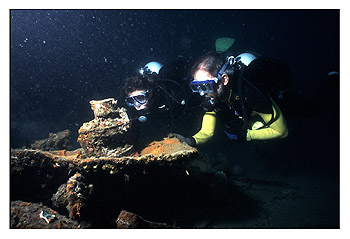 On
13 October, we used the afternoon to search for the site where
Maj. Jack Conger, of VMF-114, sank a Japanese "destroyer" on
an extremely low-level bomb run from his Corsair in November 1944. After
researching a number of references, Chip Lambert had discovered photos
taken after that raid, which clearly showed the location, relative to
distinct landmarks, of the ship debris field. While the ship would have
been salvaged for scrap metals after the war, it was possible that a debris
field might remain. Using the aerial photo found by Chip, we were able
to find the debris field with Joe's help, on the southern side of Ngargol
at a depth of 25 feet. This shallow depth permitted long scuba dives and
we were able to find a number of remaining artifacts, including a ship's
lantern (Chip), an admiralty anchor (Pat), and a brass plate (Joe) which
said in English:
On
13 October, we used the afternoon to search for the site where
Maj. Jack Conger, of VMF-114, sank a Japanese "destroyer" on
an extremely low-level bomb run from his Corsair in November 1944. After
researching a number of references, Chip Lambert had discovered photos
taken after that raid, which clearly showed the location, relative to
distinct landmarks, of the ship debris field. While the ship would have
been salvaged for scrap metals after the war, it was possible that a debris
field might remain. Using the aerial photo found by Chip, we were able
to find the debris field with Joe's help, on the southern side of Ngargol
at a depth of 25 feet. This shallow depth permitted long scuba dives and
we were able to find a number of remaining artifacts, including a ship's
lantern (Chip), an admiralty anchor (Pat), and a brass plate (Joe) which
said in English: 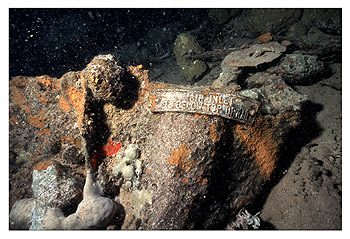 "Main
Inlet 98 Top of Rail". Since an English plate was rather unexpected,
our interpretation is that this may have been a captured British (or perhaps
Dutch) vessel that was converted for use by the Japanese Navy. Chip and
Greg took numerous underwater photographs.
"Main
Inlet 98 Top of Rail". Since an English plate was rather unexpected,
our interpretation is that this may have been a captured British (or perhaps
Dutch) vessel that was converted for use by the Japanese Navy. Chip and
Greg took numerous underwater photographs.
That evening, we met the CIHI team and Cpt. Kevin
Upson (Search and Recovery Team Leader) at the Pirate's Cove restaurant.
Although the team was primarily searching for the Babeldaob burial site,
they also were interested in the Avenger we had found in 1999 in the Peleliu
mangroves, north of the airfield (see P-MAN report dated 1 September 1999).
I provided slides of the aircraft for their files and we reviewed our
experiences in finding the crash site, since they wanted to conduct a
preliminary field search to look for remains. Also that evening we met
with Abby, the restaurant owner who in 1999 had linked the P-MAN team
up with Lazarus, who in turn had guided us to three crash sites (see
P-MAN report dated 1 September 1999). Abby told us that Lazarus had
informed him of a new crash site and ultimately arranged for our meeting
Lazarus during our subsequent exploration on Babeldaob.

