
 P-MAN
II - 4
P-MAN
II - 4 
VI. Introduction to P-MAN II Findings
Please refer to the report to Explorers Club concerning the first P-MAN Expedition, dated 1 September 1999.
VII. Findings of P-MAN II
This expedition included three continuing members (Pat
Scannon, Chip Lambert, and Pam Lambert) and two new
members: Greg Kovacs, MD, PhD from Stanford, CA and Reid Joyce
from Pittsburgh, PA. Greg, in addition to his interests in aviation history
and SCUBA diving, utilized his expertise in electrical engineering to
set up and manage the underwater magnetometer. 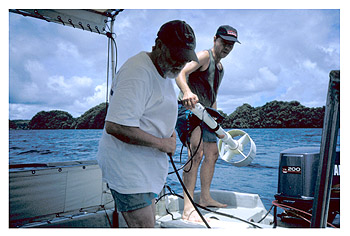 Reid,
with his background in aviation, SCUBA diving, and computer technology,
assisted Greg with the magnetometer. All members contributed to the P-MAN
II photographic/video record.
Reid,
with his background in aviation, SCUBA diving, and computer technology,
assisted Greg with the magnetometer. All members contributed to the P-MAN
II photographic/video record.
One item was added to the agenda at the last minute. Over
the six months prior to this expedition, I (Scannon) began working with
Professor Don Shuster from the University Of Guam on trying to
find the possible location of the burial site of three airman and up to
ten missionaries, executed in mid-September 1944 on the island of Babeldaob.
I supplied information concerning the possible identities of the airmen,
while Professor Shuster has concentrated on the missionaries' identities.
Because of the possibility of finding American airmen, the US Army Central
Identification Laboratory decided, based on the background work of both
sets of information, to send a team to make a preliminary field trip to
look for possible locations of the burial site. The CILHI field trip overlapped
with this P-MAN II trip.
On 7 October 2001, Greg and I picked up the magnetometer and received final instructions from Geometrics in San Jose, CA; we met Pam, Chip and Reid in LA. The trip from Los Angeles to Palau, through Honolulu and Guam, was uneventful. Professor Shuster met us at the Koror airport and updated us on the ongoing CILHI search. Since the CIHI team and Professor Shuster did not require extra hands (although we volunteered), we decided to proceed with our agenda and overlap with them where and when appropriate.
As with the P-MAN Expedition of 1999, a major part
of the P-MAN II expedition was oriented around our continued search for
the '453 B-24 in Toachel Mid. By 9 October, we had delivered all our gear
to Neco Marine (our home base) and outfitted our boat for scuba diving
as well as for the depth finder and underwater magnetometer. We began
calibration of the magnetometer (linked to a Panasonic water-resistant
Tough Book PC) by searching two known wrecks. The first was the "Helmet"
shipwreck (N 7°19.675'/E 134°27.934'). The magnetometer detected
the ship in ~70-100 feet of water with no problem. The second calibration
was on a known aircraft wreck (with a much lower iron load) at N 7°22.152'/E
134° 26.895. This Japanese Jake floatplane was sunk above a large
coral head in ~50 feet of water. This wreck turned out to be much harder
to find by magnetometer alone. We optimized the boat speed for detection
at 8-10 knots; it would be some days later before we optimized the length
of cable from the boat to the magnetometer. We searched Arupushukaru Channel
for a possible aircraft crash site (Maj. Q. B. Nelson), which we did not
find, although the magnetometer did detect a number of iron deposits.

