
 The
Search for USS Mississinewa - 5 The
Search for USS Mississinewa - 5 
Mississinewa found - at last
Given the short period of time we had remaining (to leave time for our nitrogen offgassing before the flight home), we were able to make only two dives on the ship. Before our first dive, the team on the boat stopped all activity and we held a quiet service for the dead who lay below us. We had agreed to investigate and photograph the wreck but, out of respect for this gravesite and the crew within it, not to penetrate into the ship's interior.
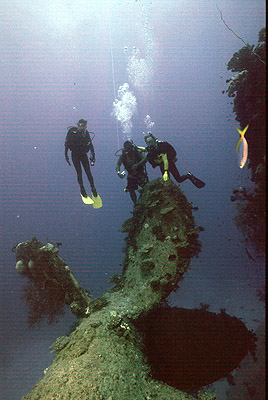
The first dive was an adrenalin-laden adventure because we tried to take in as much as we could of this 553 foot ship. The impact crater made by the submarine was enormous and resulted in the bow resting on its port side while the hull, aft of the explosion, flipped all the way over. On the bow section, the starboard 3-inch gun remained intact, now coral laden. Toward the port side, hatches to crew quarters and work areas remained permanently open. Moving to the west toward the stern along the bottom of the hull (which was now on top and surprisingly free of marine growth due to the still-active anti-fouling paint), we found the two huge screws and midline rudder intact. I took as many photos as I could.
|
|
| Page last modified 17 May 2003 | |
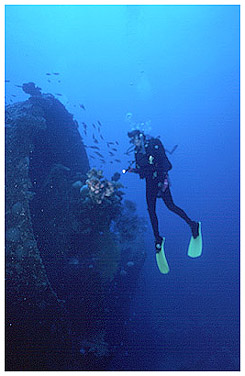 After 6 frustrating days of intense sun and rough seas, we had covered
most of the five square mile grid. On the seventh day, made available
by the generosity of Pacific Missionary Airline's owner Peter Reichert
(who changed their flight schedule to grant us more search time), computer
analysis of our GPS grid patterns revealed two unexplored holes in "the
cone". We chose one final search area, which was most consistent
with Sid's photos. At 12:10 PM, with only two boat passes left before
we would have had to quit, the depth finder screen suddenly signaled an
anomaly below - an abrupt vertical 40+ foot rise and fall, which repeated
with a second pass. Our boat was definitely over the ship. Ken jumped
into the water and made the first visual confirmation from the surface.
It became real as Pam, Pat, Faustino and I descended on it. Resting upside
down in 120 feet of water, oriented with the twisted bow pointed due east
and home to thousands of fish, was the USS Mississinewa. Almost 57 years
after she and the 63 souls who accompanied her slipped to the bottom,
the "Miss" was found.
After 6 frustrating days of intense sun and rough seas, we had covered
most of the five square mile grid. On the seventh day, made available
by the generosity of Pacific Missionary Airline's owner Peter Reichert
(who changed their flight schedule to grant us more search time), computer
analysis of our GPS grid patterns revealed two unexplored holes in "the
cone". We chose one final search area, which was most consistent
with Sid's photos. At 12:10 PM, with only two boat passes left before
we would have had to quit, the depth finder screen suddenly signaled an
anomaly below - an abrupt vertical 40+ foot rise and fall, which repeated
with a second pass. Our boat was definitely over the ship. Ken jumped
into the water and made the first visual confirmation from the surface.
It became real as Pam, Pat, Faustino and I descended on it. Resting upside
down in 120 feet of water, oriented with the twisted bow pointed due east
and home to thousands of fish, was the USS Mississinewa. Almost 57 years
after she and the 63 souls who accompanied her slipped to the bottom,
the "Miss" was found.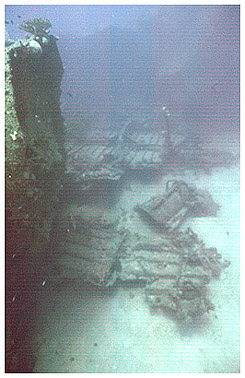
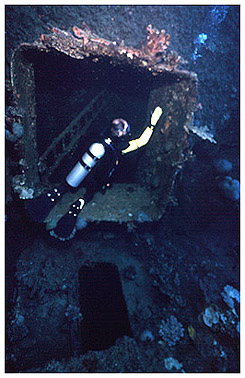
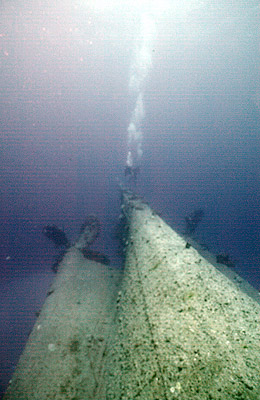
bow gun, © C. Lambert, 2001
© C. Lambert, 2001
at bottom of Ulithi Lagoon,
6 April 2001,
with twin screws and diver above centerline, © C. Lambert, 2001