
 P-MAN IV - p. 5
The Place:
Palau�s Jungles
Very simply, the land geologies of Palau are two: Babeldaob, the biggest island, is primarily volcanic, with a lot of red clay. South of Koror, most islands are coral limestone based. The middle islands, including Koror (Palau�s current capitol, are a combination of clay and coral. Although the hills of Babeldaob reach greater heights (max ~ 800 feet), the coral-based islands can rise 200 feet very rapidly from the shoreline. These islands� beauty cannot be described or even photographed with any justice � from the water or the air. You simply have to go and see it. Inside the many different jungles of Palau, the beauty is untouched and you do not have to walk inside very far to find out why.
With Palau only seven degrees above the equator, the weather is tropical and yet blessed by gentle trade winds and periodic rains, which make an otherwise hot and humid locale a paradise for tourists, mostly scuba divers, from around the world. Except for those who visit Peleliu�s battlefields, tourists rarely enter Palau�s jungles.
Palau�s jungles are really quite safe. Forget for the moment the windless heat and humidity � as long as you are carrying several liters of water with electrolytes. Critters are not usually a problem since Dengue-bearing mosquitoes don�t congregate in jungles, coral snakes reside only along the shorelines and spiders (some 6 inches in diameter and poisonous) are rarely seen. Tropical birds are everywhere. Bats, however, reside in caves (where the Japanese hid) and are very gentle. The only monkeys in Palau are on the most southern island of Angaur and were brought by the Germans as pets before WWI when they controlled Palau. Palauans do caution about looking out for trees dripping black, viscous sap, which causes severe blistering rashes if touched. The first few years, if a tree looked even remotely black (and which tree in a dark jungle doesn�t), I would jump out of the way only to be told it was not the dangerous kind. Anyway, now I just wear gloves and long sleeves. And there is no malaria in Palau.
Coral jungles and clay jungles are different. Coral bleaches white in the sun and reflects light upwards; clay, being darker, instead absorbs light. Coral limestone formations in Palau have little surface soil and rain water drains rapidly away. Clay jungles on the other hand get wet and stay wet and it does not take many footsteps to turn these jungle floors into slick mud - except for the stuff which sticks to your boots and weighs you down. However, coral and clay jungles do have at least one thing in common: the vegetation can get very dense. The denser it gets, the more you notice how much like a thermal blanket the jungle becomes � at least for the 6 feet or so off the surface where I have been. And the denser it gets, the more you miss Palau�s cooling ocean breezes.
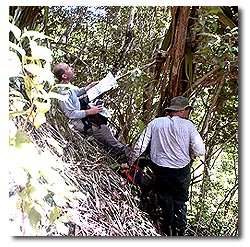
Exploring these different jungles creates different experiences. On the coral, as you climb, you use its natural nooks and crannies; on the wet clay, you crawl upwards on your hands and knees. And if you fall on coral, you do not slip and slide, you get punctured and sliced. From time to time, you do get reminded you are not alone, often at most inopportune times, such as when a land crab scurries out of your targeted handhold an instant before your (gloved) hand�s unbalanced purchase; there are other more private situations, best left unstated, where land crabs can be, well, disruptive. But the one item, which becomes the climber�s scourge (follow-on pun intended) particularly on these coral islands, is a type of vine, more thorn than vine actually, that has a habit of finding the most delicate and inaccessible regions of a climber�s anatomy. Long sleeve shirts, gloves, neck protection, hats, glasses, long sturdy pants and boots with long socks all help, but these vines, so intimate with the coral, mock all efforts to avoid them. I have seen machetes in the hands of skilled users bounce off these cursed vines and even successful transection comes at a cost � forward progress is often measured only in tens to very few hundreds of feet per hour.
These coral hills redefine the word �jagged�. Thousands of years of exposure to rain and heat have etched into the coral limestone infinite numbers of holes of all sizes leaving the residual rock with correspondingly infinite points and edges. We learned quickly that even expensive boots literally exfoliate their treads on this �porcupine� coral and, for that reason alone, more than one pair of our boots did not make the return trip back to the States. Even the Palauan guides have a rough time of it in the coral hills. As team medical officer, I patched them up as much as the rest of the team � unheard of elsewhere in my experience within Palau. In the clay jungles, when the going gets tough, our guides take off their flip-flops and go barefoot � not so up in the coral hills. As a physician, I have never cleaned in such a short period of time so many wounds and applied so many bandages to so many unusual locations, myself included.
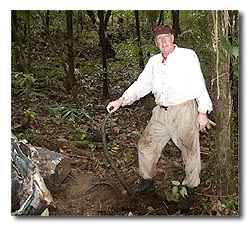
The clay jungles in my experience seem to have higher trees but that may be a function of my specific journeys there. It gets darker in the clay jungles and you notice it because you stow your sunglasses. You don�t need a flash for your camera on coral hills (usually) but you do on clay. Most feel the heat more in the clay jungles � perhaps because of the tremendous humidity. On coral, you may feel like you are sweating blood as you make your way but in the clay jungles, you bleed sweat. On P-MAN IV while hacking my way through some dense elephant grass on Babeldaob, I felt a thick stream of warm fluid trickling down my abdomen and immediately thought I had sliced a vein - instead, I saw rivulets of my sweat. I had no idea that much sweat can flow out of a living human body at once.
On P-MAN IV, we did not spend much time exploring
mangroves as in past expeditions � a truly different experience as you
travel waist-to-chest deep in black sucking muck. Sometimes when you stop
to get your breath, you can feel something nibbling on you below, but
you cannot see what. The Palauans say saltwater crocs live in there �
and I believe them but have yet to see one. I�ll save mangrove stories
for another time.