
 P-MAN III - 2
SUMMARY OF GENERAL FINDINGS of P-MAN III: This expedition was quite eventful, specifically identifying two new American crash sites (one together with CILHI and one separately by the P-MAN III team), as well as locating with CILHI the probable exhumation site of the executed airmen and missionaries. Two Japanese fighters, without evidence of human remains, were also found and documented. As with prior reports, frequent mention is made here of recording Global Positioning System (GPS) readings, without listing these readings. US and Palauan agencies continue to request our not publicly releasing such readings so as to prevent scavenging and unauthorized salvaging; I have reported all recorded positions to these agencies. In certain instances, crash sites are also the source of continuing investigations for associated MIAs. Key findings include:
- TBM-1C Avenger/Ngeregong: This crash site,
found by the P-MAN III team, is the debris field of a TBM-1C Avenger
lost 10 November 1944 on a coral reef just south of Ngeregong. Although
we found no human remains, the after action report states that, while
the remains of the gunner were recovered two days later (exactly 57
years earlier from the day we found this crash site), the remains of
the aviator, Squadron Commander Major Harry Scullin of VMTB-134 and
his radio operator, Sgt. Bertrand Smith, were never recovered. As is
my custom, we held a small ceremony at the crash site with an American
flag, which will be sent to a surviving family member. For additional
information, see the Ngeregong/Scullins/Smith/TBM-1C attachment below.
- F4U-1D/Ngeremlengui: The second crash site,
discovered on our last expedition (P-MANII) in the Ngeremlengui State
on the island of Babeldaob, was confirmed in conjunction with CILHI
to be that of a specific F4U-1D Corsair. Although we have been able
to identify from records the aviator's name and unit, we found no human
remains during this preliminary ground search. As CILHI is currently
evaluating data to determine the possibility of remains still being
in vicinity of the crash, no further details about this aviator, or
his name, can be released at this time. (NOTE: I held an American flag
ceremony last year at this site.) For additional information, see Ngeremlengui/VMF-122/F4U-1D
attachment below.
- Search for Executed POW Remains/Ngatpang:
Together with CILHI and Professor Don Shuster, University of Guam, we
have worked with local Palauan elders having first hand historical knowledge
to locate a potential execution site in the Ngatpang State of Babeldaob.
Multiple sources of evidence (including these locals) indicate that
somewhere in the immediate area we investigated in Ngatpang State lie
the remains of three American USAAF airmen, combined with the remains
of ten executed priests, missionaries and family members. They were
executed in September 1944 and buried in a common grave until exhumation
by the Japanese military at war's end. According to War Crimes Trial
testimony by captured Imperial Japanese Army (IJA) soldiers, the Japanese
then cremated these exhumed remains and reburied the ashes/bones near
the original gravesite to hide discovery of these atrocities. The site
of the original execution and burial that we actually found (GPS- and
photo-documented) is consistent with both the recollections of the locals
and the War Crimes Trial testimony, which contain diagrams recorded
in the late 1940's. CILHI is currently evaluating whether additional
exploration of this site and adjacent areas to find the cremated remains
should be considered. On site, we held a ceremony with an American flag,
which I will present to the 307th Bombardment Group (Heavy) (BG(H))
Reunion Group of the 13th Army Air Force (AAF), from which these executed
airmen originated. This area is only the second execution site found
in Palau to date, although evidence, including from living former Japanese
Army officers, is mounting that multiple executions by Japanese military
of American POW's occurred there during WWII. For additional information,
see Ngatpang/execution/POW's attachment below.
- Hamilton-Standard Propeller/ SW Koror:
While investigating a lead for a Corsair belonging to Major Quintus
B. Nelson shot down in the Koror area in 1945, I came across a Hamilton-Standard
propeller sitting in the yard of a Palauan home in Koror. This type
of propeller could have come from a variety of American aircraft, ranging
from single engine fighters to 4-engine bombers. However, measurement
of this prop's blade diameter was consistent with that of a B-24. Interviews
of neighbors revealed that this prop was brought to this site by a now-deceased
Palauan from the wing of a B-24 on Iberor Island. This is a wing I found
and described in 1994: it belonged to the "Brief" ('058),
lost 4 May 1945. For additional information, see www.bentprop.org for
a description of this B-24 (Custer, '058) and below for the SW Koror/B-24
Hamilton-Standard Propeller-Custer/7thAAF attachment.
- Two Japanese Fighter Crash Sites/ Ngeremlengui:
Incidental to the above findings, a local guide in Ngeremlengui State
on Babeldaob took us to two additional crash sites (he did not know
the origin of these aircraft). We identified one as a Japanese Zero
and the other tentatively as a Japanese Tony. No human remains were
found. For additional information, see Ngeremlengui/Japanese Aircraft
attachment below.
- Future Investigations: In addition, I continued
my historical inquiries with local Palauans and, as a result of this
expedition, I now have at least 15 new leads of possible American crash
sites to investigate on subsequent expeditions (the next being P-MAN
IV).
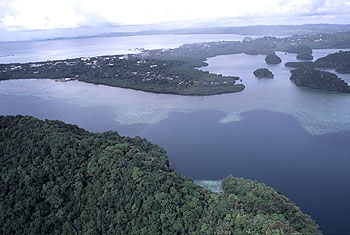 To gain a visual perspective of these reported sites,
the P-MAN III team rented a Cherokee aircraft from Belau Air and overflew
as well as videoed, using two cameras, most of the Palau Islands, placing
emphasis on where American aircraft were reported or known to have crashed.
To gain a visual perspective of these reported sites,
the P-MAN III team rented a Cherokee aircraft from Belau Air and overflew
as well as videoed, using two cameras, most of the Palau Islands, placing
emphasis on where American aircraft were reported or known to have crashed.
These crash sites generally divide into two types of leads, ones referring to sites associated with known airmen and ones of unknown origin (e. g., could be American or Japanese). In particular, on this past trip, I interviewed several Palauans in the Koror area who described five areas, which may be aircraft crash sites, between western Koror, Arupushukaru and Malakal Harbor. These sites, reported by Palauans, are in the general area where (at least) two American airmen,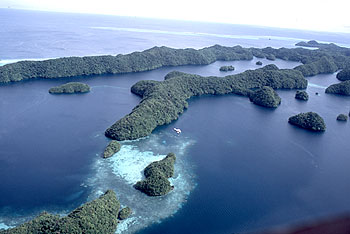 Major Quintus B. Nelson, VMF-122, and Lt. Richard
Houle, VT-51, were observed to crash. Several additional sites in other
areas, if they turn out to contain aircraft debris, are more difficult
to associate with specific American airmen, based on military after
action reports from the time. An interesting phenomenon that has occurred
on recent expeditions is the growing cooperation of the Palauan people,
at all levels, with the members of the P-MAN teams in locating such
WWII wreckage. While the Palauan people have always been friendly and
helpful to us, I believe Palauan interest is growing because of their
increasing recognition that our documentation efforts are rightfully
part of their Palauan history as well.
Major Quintus B. Nelson, VMF-122, and Lt. Richard
Houle, VT-51, were observed to crash. Several additional sites in other
areas, if they turn out to contain aircraft debris, are more difficult
to associate with specific American airmen, based on military after
action reports from the time. An interesting phenomenon that has occurred
on recent expeditions is the growing cooperation of the Palauan people,
at all levels, with the members of the P-MAN teams in locating such
WWII wreckage. While the Palauan people have always been friendly and
helpful to us, I believe Palauan interest is growing because of their
increasing recognition that our documentation efforts are rightfully
part of their Palauan history as well.
- Per protocol, CILHI notified the Palau Historical
Preservation Office of their findings. Per my protocol, I am also in
process of notifying CILHI, the U. S. Naval Historical Center and the
Palau Historical Preservation Office of my findings. I am in process
of updating several military reunion groups on these findings. An update
will also appear on this Web site.
A special note of appreciation goes to all the staff of Neco Marine who really made the operation of this expedition work. To Joe Maldangesang, master guide, and Jan Yates, as well as owners Mandy and Shallum Etpison and all the staff:
THANKS from the P-MAN III team!