| P-MAN X Update #20
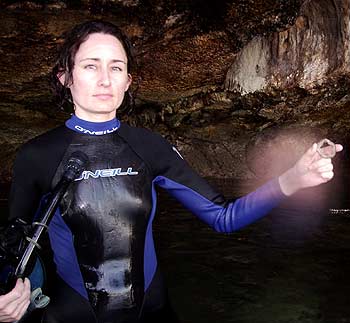
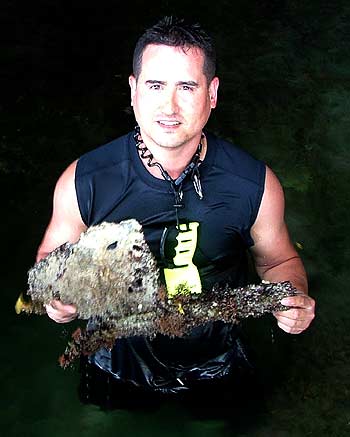
- First finds, interviews First, a couple of points about omissions from a couple of previous reports: In the Tabecheding-river-wading report (#18), since I was one of the people flailing around in the water, I completely glossed over the fact that Laura was the only team member with enough sense to follow the river from up in the jungle. She stayed relatively dry. Soaked from crawling through the jungle, but at least her boots didn't squish when she walked. She definitely gets credit for being smart enough to stay out of the river. Although getting dunked repeatedly was kind of fun... Also, she and Grover made their first independent finds of genuine aircraft chunks near the big cave where Grover also first discovered the bones, and I failed to acknowledge those rites of passage. Here's proof:
Now for today's activities. We had several potential contacts fall through early in the day. Individuals who had planned either to do some searching BEFORE guiding us to targets or who were going to meet us for various purposes just didn't come through. We had backup plans in place for some interviews, though, so we decided to start the day by driving up to Ngiwal, on the east coast of Babelthuap, north of the Capitol in Melekeok. We headed over to Neco where Joe dropped his car, and between the time we stopped to drop something off at the office and the time we all jumped back into the van, the van wouldn't start. Stone cold dead. No starter cranking. Not even any pretty warning lights on the dash. We troubleshot for about 15 minutes. We decided that the symptom was most likely related to the battery. But we couldn't find the battery. This is one of those vehicles with a diesel engine basically under the front seats. There's no hood at the front of the vehicle; to check the engine, you open the left (passenger's) door, flip a couple of latches, and lift the whole front seat up. There's the engine. But no battery. When we finally found it under the floor mat in back behind the driver's seat, we could see that the ground clamp was loose. Joe tightened it, and presto! A new van. Of course, by that time Grover had already phoned Sam's, lined up a loaner vehicle, hiked over there, picked it up, and returned to Neco. So we followed him right back to Sam's, dropped off the shortest loaner deal on record - with great thanks - and got back on the road. We made a couple of administrative stops, one of which was to drop off the revised addendum to our proposal at HPO, to secure permission to extend our search area into Airai and Peleliu states. Rita liked the proposal and said she'd have the revised permit ready by the end of the day. Then it was on to Ngiwal. The 84-year-old elder in Ngiwal is a person we interviewed back in 2005, who had some information about one or more Japanese caves in the hills near where he lives. His description of the caves' location fell far short of enough info to find them on our own, but he was willing to accompany us in the car to show us where one would depart from the road to go to the caves. Once again Grover worked his magic: the elder spoke excellent Japanese, so he and Grover chatted in Japanese as we drove. The road back to the point of departure was a but worse than the typical Palauan back road. By that I mean it was mainly a single lane, and there were places where weeds and branches scraped both sides of the car at the same time. The combination of the rough, rutted, rocky surface and the van with no shocks made the ride much as I imagine it would be like to spend a half-hour riding in a clothes dryer. After a couple of false alarms, we finally stopped at a spot where the elder said the entry into the jungle might be. But he wasn't sure. He described the area as it had been during the Japanese occupation, and said that if we had a good metal detector we might be able to find the site in something more than three days. Hmmmm. He couldn't point out an actual spot where HE would launch into the jungle. And he couldn't take us to the spot himself, because at 84 his knees wouldn't handle the hour-or-so hike that he said it would take someone who actually knew where he was going to reach the spot. Then there was that part about its probably taking more than three days to find the actual site with a metal detector, assuming you knew what you were looking for. Our interest in this cave site derives from part of his story about the Japanese filling the caves with a bunch of stuff - guns and bombs, yes, but also other stuff in boxes, possibly records. We've heard stories about the Japanese packing up tons of written records toward the end of the war and stashing them in caves in this general area, then sealing the caves. We'd dearly love to find records that could help us to locate the execution and burial sites of the missionaries and the American POWs. But it may well be beyond our resources to do a metal-detector search of many square miles of jungle. I'm not saying we're giving up on this site, but the likelihood of that kind of near-random search did not shift this site much higher on my priority list. We took the return half of the 30-minute clothes-dryer ride to get back to the main road, then drove the elder back to Ngiwal. On the way back, we stopped by the new National Capitol and briefly paid our respects at a new memorial to the 2,000 or so Koreans who were enslaved as laborers by the Japanese occupiers and who were killed here in Palau during the war. Back in Koror, we stopped by the Historical Preservation Office to pick up our amended permit that's been expanded to cover Airai and Peleliu, then dropped packs back at the room and immediately headed over to Meyuns, at the east end of Arakabesan, to interview a Palauan elder who had worked with the Japanese during the war. On the way to Meyuns across the Arakabesan-Koror causeway, we stopped to pay our respects to the wreckage of an Avenger that was visible at this evening's very low tide. After completion of the interview, we headed to Kramer's. Spaghetti night. - Reid |

- Main Site
- Expeditions
- Our Story
- Miscellany